Showing posts with label changes perspectives. Show all posts

Friday, June 22, 2018

After the Fall

Title:  After the Fall: How Humpty Dumpty Got Back Up Again
Author/Illustrator: Dan Santat
Publisher Roaring Brook Press © 2017
ISBN:  978-1-62672-682-6
Grade Level:  K-5
Book Review: Have you even considered what happened to Humpty Dumpty after the fall?  We know that our past experiences shape our beliefs and in this story Dan Santat provides rich food for thought about just how impactful the fall was to Humpty Dumpty. Santat teaches a powerful lesson about resilience as we learn that even though Humpty Dumpty took a fall, he also got back up.
Systems Thinking Connections:
Habits:  No doubt, students with any familiarity with the Habits of a Systems Thinker could generate a substantive list of the Habits that Humpty uses in this story.  He definitely changes his perspective, practices successive approximation, and he finds leverage to help his problem.
Tools: Humpty Dumpty takes actions that help him accumulate courage to try find a way to get back up. Build a stock-flow diagram with students and then ask questions to help them identify the leverage that helps Humpty move from being a broken egg to being a systems thinker.


Thursday, August 31, 2017

Lucky Ducklings

Title:  Lucky Ducklings
Author:  Eva Moore
Illustrator: Nancy Carpenter
Publisher: Orchard Books,  © 2012
ISBN:  978-0-439-44861-1
Grade Level:  PreK-2
Book Review:  Lucky Ducklings, a true rescue story, is about a mama duck and her five baby ducklings. As the ducklings follow their mama around town, one duckling falls through a storm grate. Thanks to an attentive passerby and a dedicated crew of fire fighters the duckling is rescued.  Mama and babies continue on their way. A well written story, with beautiful illustrations, and a timeless theme make a picture book that could certainly become a classic.
Systems Thinking Connections:
Habits: This story easily lends itself to a discussion of Mama Duck's point of view and thus the Habit changes perspective to increase understanding.  Children can relate to being separated from a parent. The fears of both the mama and her ducklings draw children into the story and create opportunities for conversation.
Tools: A great book for introducing young readers to behavior-over-time graphs.  I was reminded of this story as the start of the school year has prompted primary teachers to ask for recommendations of books that make introducing this tool accessible to young learners.  Lucky Ducklings is such a story. The preschool teacher who created the graph shown here shares that her students had quite a conversation about when to make the line go up, showing that the mother duck was worried.  Some students wanted to indicate the change when the duck fell through the grate.  Other students argued, quite convincingly, that the change for mother duck, did not come until she was aware her duckling had fallen.  This conversation illustrates the power of a visual systems thinking tool to promote deep thinking and create the conditions for children to construct meaning.


Wednesday, March 9, 2016

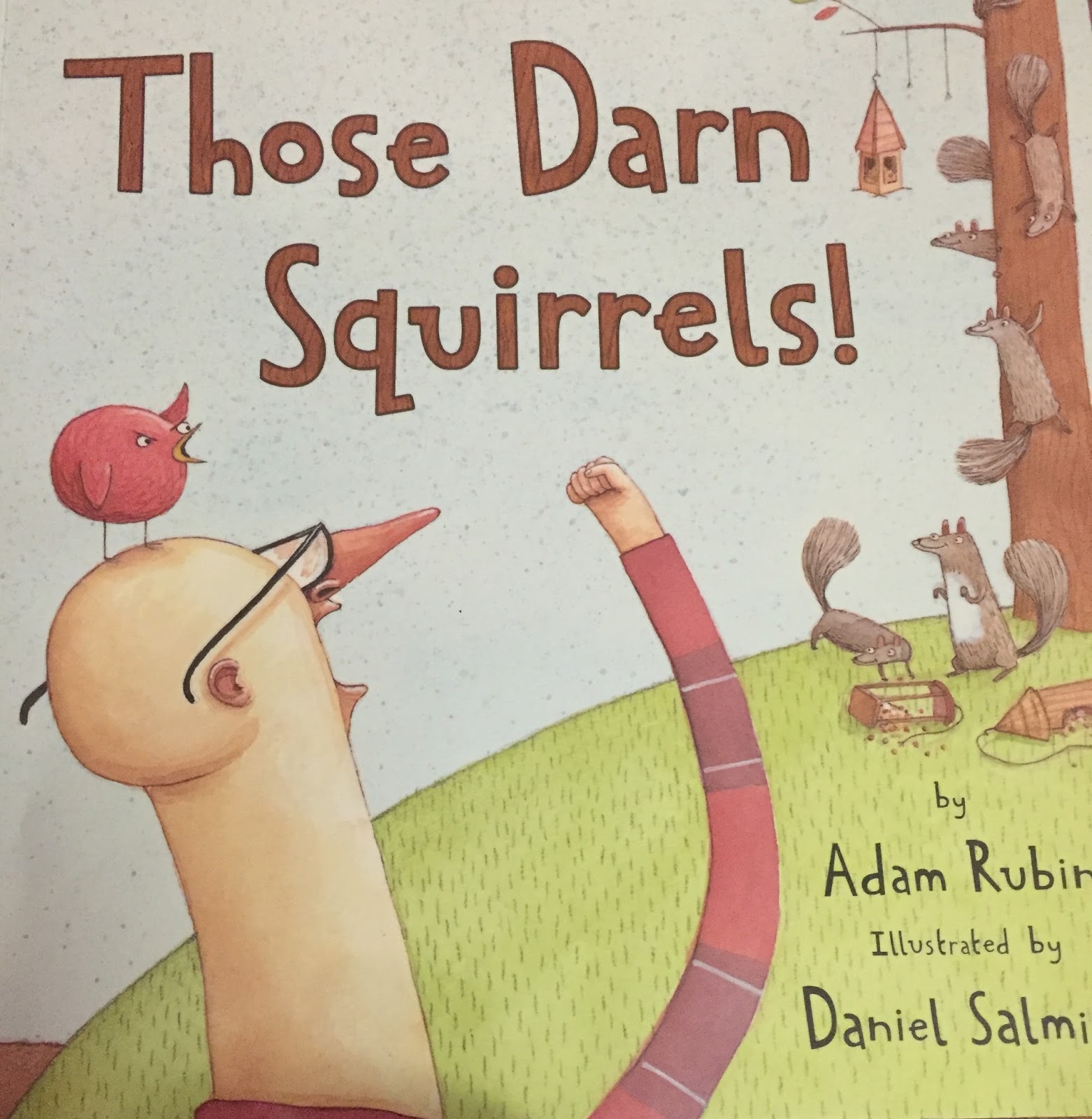
Those Darn Squirrels

Title:  Those Darn Squirrels

Author:  Adam Rubin
Illustrator:  Daniel Salmieri
Publisher:  Sandpiper ©2008
ISBN:  478-0-547-57681-7
Grade Level:  K-5
Book Review:  Old Man Fookwire doesn't like very many things, but he does love birds.  He feeds them, paints pictures of them and mourns every winter when they leave for a warmer place. As much as he likes his birds, he dislikes the conniving squirrels that come to live on his property.  That is until they find a very clever way to win his heart.  The story can be read on many levels.  It can be read purely for pleasure.  The reader can take away a lesson about the importance of appreciating differences and resolving conflicts.  Or the squirrels ingenuity can inspire young engineers.  Whatever the reason, it is a delightful read.

Systems Thinking Connections: 
Habits: Those Darn Squirrels offers students multiple opportunities to examine how characters in the story practice or don't practice the habits of a systems thinker, making it an ideal book for helping students understand the habits.  After reading the book aloud to a group of fourth grade students, each group of 4 to 5 students took a set of habits cards and selected one to which they could make a connection with the story.  Their connections were excellent and their understanding of the habits as applied to the scenarios in the book were very accurate and reasonable.  Students recognized how Old Man Fookwire and the squirrels learned something by changing their perspectives to increase their understanding.  Students also noted how the squirrels benefited when they took the time to consider an issue fully and resits the urge to come to a quick conclusion.
Tools:  A group of second graders in  used a Behavior Over Time Graph to track the squirrels level of frustration.  You will note from the key that these students also read the sequels to the original story. Comparing the frustration of the squirrels and Mr. Fookwire at various points in the story  produced deeper understanding and comprehension of the text.  
Another thing to note in this graph is how readers cite textual evidence by making notations on the graph itself, showing what is affecting the level of frustration.  Systems tools are powerful ways to help students make connections to a text and document those connections using evidence from the text.  
Special thanks to Christina Wamboldt, Hewlett ElementarySchool, Hewlett-Woodmere School District, for sharing this piece of student work.

Thursday, October 29, 2015

What's Up with This Chicken?

Title:  What's Up with This Chicken?
Author:  Jane Sutton
Illustrator:  Peter J. Welling
Publisher:  Pelican Publishing ©2015
ISBN:  978-1-4556-2085-2
Grade Level: K-5
Book Review:  Jane Sutton's books frequently appear in Literature Connects because she has a tremendous talent for taking real life experiences and creating delightful narratives that both inform and entertain. Jane definitely doesn't disappoint in her newest release, What's Up with this Chicken? It is a wonderful story filled with interesting information about chickens and is told in Sutton's signature style: believable characters, magnificent humor and plenty of word play. The book contains a powerful embedded message about how to resolve conflicts by changing your perspective. Trudy refuses to get off her eggs. Sylvia can't understand why. Under the tutelage of a wise grandmother, Sylvia comes to understand that Trudy is not difficult, she is really just broody. Don't miss out on this "egg-cellent" book. It is appropriate for students PreK-5 because it can be read and enjoyed on so many levels. 
Systems Thinking Connections
Habits:  Sylvia and her grandmother could easily become frustrated with Trudy and decide that she has outlived her usefulness as an egg-laying chicken; instead, they consider the issue fully (including doing some important research) and resist the urge to come to a quick conclusion. As a result, they recognize that there is a reason for Trudy's behavior, her desire to mother chicks is a fundamental structure of Trudy's natural make up. A deep but meaningful example of recognizing that a system's structure generates its behavior. They surface their assumption--Trudy is a broody hen--and then test their assumption by purchasing some fertilized eggs. For younger children simply recognizing how changing their perspective helps Sylvia and her grandmother increase their understanding is a very worthwhile connection.
Tools:  Conflict is central to any good story. The conflict resolution is particularly strong in What's Up with This Chicken? So much so, that children could use this balancing loop to explain how conflict in this story is resolved.
Here is one way to "tell the story of this loop." As the conflict increases, Trudy refuses to get off her eggs) Sylvia works to resolve the situation. As Sylvia's effort at resolving the conflict increases, the conflict decreases because Trudy is happily sitting on her eggs and caring for her chickens. Sylvia's need for resolution strategies goes down because she is focused on Trudy's new role as a mother hen. Over time the chickens grow up and Trudy needs more fertilized eggs. In addition, Sylvia learns that one of Trudy's offspring is also a brooding hen. As Judy now refuses to allow Sylvia to collect the eggs (conflict), Sylvia will have to work to resolve the conflict (providing Judy fertilized eggs) so the conflict decreases. Using a causal loop to focus on the conflict helps students understand more deeply conflict in a story. Students could also use this loop to tell their own story about a conflict that resolves but over time manifests itself in a slightly different way.
The ladder of inference would also be a good tool to use with What's Up with This Chicken?. When faced with a conflict with Trudy, Sylvia and her grandmother add information to their pool of experience by reading in a book about chickens. They use that information to make a more informed decision in caring for Trudy and as a result have a happier chicken. Students could go up and down the ladder from both the perspective of Sylvia and Trudy.